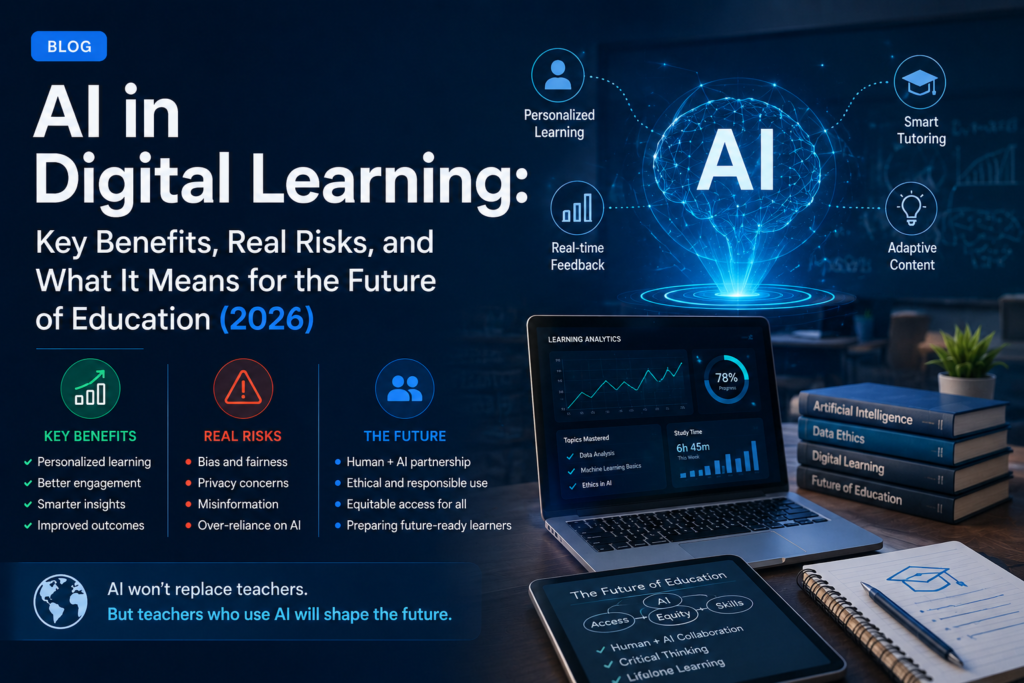
Artificial intelligence is no longer a futuristic concept whispered about in academic circles. It is sitting inside classrooms, corporate training rooms, and online learning platforms right now — grading assignments, tutoring students at midnight, translating lessons into a dozen languages, and flagging learners who are quietly falling behind.
But with every breakthrough comes a legitimate question: Are we moving too fast?
In this guide, I break down exactly what AI is doing inside digital learning environments today, the real and measurable benefits it delivers, the risks educators and institutions cannot afford to ignore, and what the research tells us about where this is all heading. Whether you are a teacher, a student, an EdTech professional, or a parent trying to make sense of it all — this is for you.
Table of Contents
What Is AI in Digital Learning, Exactly?
Digital learning refers to any educational experience delivered through technology — online courses, e-learning platforms, virtual classrooms, mobile apps, and blended learning environments. AI in digital learning means that intelligent systems are now embedded into these experiences to personalize, automate, and enhance how people teach and learn.
In practical terms, this looks like:
- An intelligent tutoring system that adapts quiz difficulty based on your past performance
- A chatbot that answers a student’s question at 2 AM when no teacher is available
- An AI tool that flags a student’s declining engagement before they drop out
- An automated grading system that saves a teacher hours each week
- Content generators that help educators build lesson materials in minutes
The technology is already widespread. Global student AI usage jumped from 66% in 2024 to 92% in 2025, and by the start of 2026, it is estimated that 86% of all students in higher education use AI as their primary research and brainstorming partner.
This is not a trend. This is a structural shift in how education works.
The Market Behind the Movement
Before diving into benefits and risks, it helps to understand the scale of investment driving AI in education. According to Grand View Research, the global AI market in education was valued at approximately USD 8.35 billion in 2025 and is projected to grow at a compound annual growth rate of 31.2% from 2026 to 2030.
That kind of growth does not happen unless the technology is delivering real results — and in many cases, it is. But scale also brings pressure, and pressure introduces risk. Let’s look at both honestly.
The Real Benefits of AI in Digital Learning
1. Personalized Learning That Actually Works
The most powerful thing AI can do in education is something that a single teacher with 30 students almost never can: give every learner a completely individualized experience.
Traditional classrooms move at one pace. Some students are bored while others are lost. AI-powered platforms track individual performance in real time, adapt the difficulty of content, recommend the next lesson based on where a student is struggling, and deliver feedback immediately — not days later when the moment has passed.
Key benefits of AI in education include personalized learning experiences that adapt to individual needs, immediate feedback that accelerates learning, improved student engagement and motivation, and better learning outcomes and test scores.
The evidence on outcomes is striking. A 2025 Harvard University physics study found that students using AI tutors learned more than twice as much in less time compared to those in traditional active-learning classrooms.
That is not a marginal improvement. That is a transformation in learning efficiency.
2. Massive Time Savings for Teachers
One of the most underappreciated benefits of AI in digital learning is what it does for educators, not just students.
81% of teachers say AI saves them time when completing administrative work, 80% when preparing to teach, 79% when grading, 74% when modifying materials to meet the needs of students, and 65% when supplementing teaching.
Weekly AI users among teachers save nearly six weeks of time per year.
Six weeks. That is time teachers can redirect toward the deeply human work that no algorithm can replicate: mentoring, motivating, connecting, and inspiring. AI does not replace great teachers. When used well, it gives them back the time to actually be great teachers.
3. Early Identification of At-Risk Learners
One of AI’s most quietly powerful applications in education is in identifying students who are struggling before those struggles become failures. Learning analytics systems can detect patterns — declining engagement, slower response times, repeated errors on certain concepts — and alert educators early.
Early identification of at-risk students is among the key benefits of AI in education, alongside more efficient corporate training programs that show a 57% increase in learning efficiency.
In corporate learning and development contexts, usage is expanding beyond content production into analysis, implementation, and evaluation, with teams using AI to synthesize feedback, cluster learner data, identify content gaps, and inform portfolio decisions.
4. Accessibility and Inclusion
AI is dramatically expanding who can access quality education. Real-time translation tools are breaking language barriers. Text-to-speech and speech-to-text technologies are giving learners with disabilities new pathways to engage with content. AI tutors are available around the clock, which matters enormously for learners in remote areas or those who cannot attend traditional institutions.
At Macquarie University, AI utilization resulted in an increase of up to 10% in student exam results, demonstrating clear academic benefits.
5. Scalable Corporate and Professional Training
Beyond formal education, AI is transforming how organizations train their workforces. From onboarding new hires to upskilling teams for new roles, AI-powered learning platforms can deliver personalized training at scale — something that was practically impossible with traditional instructor-led programs alone.
The Real Risks of AI in Digital Learning
This is where many articles go soft. They list the benefits enthusiastically, then offer a few vague concerns before concluding that AI is basically wonderful. That is not good enough — and it is not honest.
Here are the risks that genuinely deserve your attention.
1. Learning Without Actually Learning
This is perhaps the most important risk, and it comes directly from the OECD’s most recent research. The OECD Digital Education Outlook 2026 highlights that while general-purpose generative AI tools can enhance students’ performance on tasks, they do not necessarily lead to real learning gains. Offloading cognitive tasks to general-purpose chatbots creates risks of what researchers call “metacognitive laziness” — a disengagement that may deter skill acquisition in the long run.
Put simply: a student can get a better grade using AI without actually learning anything. And if the goal of education is genuine capability — not just task completion — that is a serious problem.
The OECD recommends moving beyond general-purpose AI tools toward purpose-built educational AI that is designed to produce durable learning gains, not just better task outputs.
2. Academic Integrity Is Under Pressure
Lower secondary teachers believe AI can harm academic integrity by letting students pass off AI-generated work as their own. This concern is widespread among educators at every level.
Detection tools are being developed and improved, but it remains an arms race. The deeper issue is not just cheating — it is that AI makes it easier than ever to produce the appearance of knowledge without possessing it.
3. Data Privacy and the Question of Whose Data It Is
AI systems in education are, at their core, data machines. They work by collecting enormous amounts of information about how students learn, what they struggle with, how long they spend on tasks, and what patterns emerge over time.
Students are increasingly aware of the societal risks associated with AI, including algorithmic bias, data privacy concerns, and job losses due to automation.
Most teams avoid using personal or sensitive learner data with AI — around 59% — which keeps experimentation focused on low-risk content tasks. But as AI adoption deepens, the boundaries of what data is collected and how it is used will come under increasing scrutiny.
Schools and platforms need robust data governance policies, and parents and students need real transparency about what is being collected and why.
4. The Equity Gap Could Widen
AI has the potential to democratize education. It also has the potential to widen existing inequalities. Schools and districts with resources can afford the best AI tools, the best training for teachers, and the infrastructure to support them. Under-resourced schools often cannot.
According to UNESCO, only 10% of schools and universities have established guidelines for using AI. Without deliberate policy intervention, the schools that already have advantages will pull further ahead — and the students who most need personalized support may be the last to receive it.
5. Teacher Unpreparedness Is a Real Problem
AI tools in the classroom are only as effective as the teachers implementing them. And right now, most teachers are not ready.
71% of U.S. K-12 teachers currently lack formal training on AI in education. Deploying sophisticated technology without equipping the people responsible for using it is a recipe for poor outcomes — and in some cases, harm.
Only 35% of school districts state they have a generative AI initiative in place. The gap between technology availability and teacher preparedness is one of the most urgent challenges the sector faces.
6. Emotional Intelligence Has Limits
AI tutors are impressive. But they are not human. Human tutors can interpret student emotional states with 92% accuracy, while even the most advanced AI tutoring systems currently manage only 68% accuracy.
Learning is not purely cognitive. It is emotional. Students who are anxious, grieving, distracted, or struggling with mental health need human connection — and no chatbot, however sophisticated, can fully provide that.
What Does the Research Tell Us About the Path Forward?
The honest answer is that we are still in early days. The technology is moving faster than the research on its long-term effects. But a few things are becoming clear:
AI works best as a complement, not a replacement. Educational institutions are adopting AI-powered tools such as Intelligent Tutoring Systems, chatbots, and learning analytics to enhance student engagement and optimize teaching methods — the key word being “enhance.” The most effective implementations pair AI capabilities with human judgment, not against it.
Purpose-built matters more than general-purpose. A general chatbot and an AI designed specifically to teach algebra with pedagogical scaffolding are very different tools. The latter has far more potential to produce real learning gains.
Policy and governance must keep pace. The OECD Digital Education Outlook 2026 is an essential resource for education policymakers, institution leaders, and researchers navigating the opportunities and key challenges of generative AI in education. Without deliberate oversight, the risks will compound.
Student awareness is growing. Students increasingly understand that AI is not just a technological trend but an important tool — and they are aware of both its capabilities and its limitations for their future employability.
FAQ: AI in Digital Learning
Q: Does AI actually improve student learning outcomes? In well-designed implementations with appropriate pedagogical guidance, yes — sometimes dramatically. But without that structure, AI can improve task performance without improving actual learning.
Q: Is AI going to replace teachers? No — and the research is consistent on this. AI handles repetitive and administrative tasks well. The irreplaceable work of teaching — mentoring, relationship-building, emotional support, and inspiring curiosity — remains deeply human.
Q: What is the biggest risk of AI in digital learning? The most underrated risk is cognitive offloading: students using AI to complete tasks without actually engaging with the material. This produces better outputs but not better learners.
Q: How should schools approach AI adoption? Start with specific, low-risk use cases. Invest in teacher training first. Establish clear data governance policies. Measure outcomes, not just usage. And involve teachers, students, and parents in the process.
Q: Is AI in education accessible to everyone? Not yet. Access to quality AI tools in education remains unequal across income levels, geographies, and school resources. Bridging that gap requires deliberate policy and investment.
Final Thoughts
AI in digital learning is not a silver bullet. It is a tool — one that can be genuinely transformative when deployed thoughtfully, and genuinely harmful when deployed carelessly.
The benefits are real: personalized learning at scale, significant time savings for educators, earlier identification of struggling students, and improved outcomes in well-structured environments. The risks are equally real: learning without learning, widening equity gaps, data privacy concerns, and a workforce of educators who have not been adequately prepared for the shift.
The institutions, educators, and policymakers who will navigate this era successfully are the ones who approach AI in education with curiosity and skepticism in equal measure — asking not just “Can we use this?” but “Should we use this here, in this way, for these students?”
That question deserves a thoughtful answer every time.
Have thoughts on AI in your own learning or teaching experience? The conversation around AI in education is evolving rapidly — and the most important perspectives often come from the people inside the classroom.